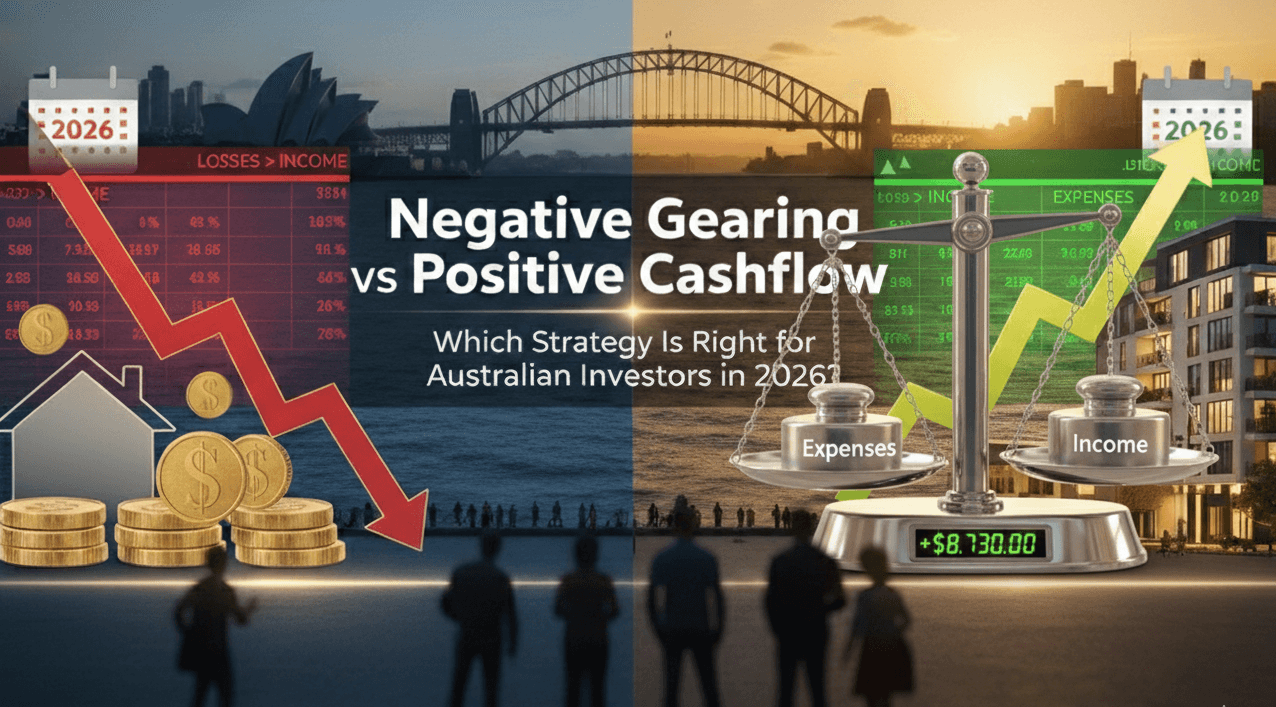
If you've spent any time researching property investment in Australia, you've encountered the debate: should you negatively gear for capital growth, or target positive cashflow from day one?
The honest answer? Neither strategy is universally "better." The right approach depends on your income, your risk tolerance, your investment timeline, and the current economic conditions. Let's break it down.
What Is Negative Gearing?
Negative gearing occurs when the costs of holding an investment property (mortgage interest, maintenance, insurance, management fees) exceed the rental income. The resulting loss can be deducted against your taxable income, reducing your overall tax liability.
Example: You earn $120,000/year salary. Your investment property generates $25,000 in rent but costs $35,000 to hold. The $10,000 loss reduces your taxable income to $110,000, saving you approximately $3,700 in tax (at the 37% marginal rate).
When Negative Gearing Works
- High income earners (above $120,000) who benefit most from the tax deduction
- Long-term holders (7–10+ years) who can ride out the holding costs while the property appreciates
- Capital growth markets where strong appreciation over time more than compensates for the annual shortfall
- Investors with stable employment and confidence in their ongoing ability to fund the gap
The Risks of Negative Gearing
- You're losing real money each year, betting on future capital growth that isn't guaranteed
- Interest rate rises can significantly increase holding costs, a lesson many investors learned the hard way in 2023–2024
- Policy risk: there's ongoing political discussion about reducing or removing negative gearing benefits
- Reduces your borrowing capacity for the next property purchase
What Is Positive Cashflow?
A positive cashflow property generates more rental income than it costs to hold. After mortgage payments, rates, insurance, and management fees, there's money left in your pocket each week.
Example: Your property costs $450,000 with a $360,000 loan. Weekly rent is $480. After all expenses (mortgage, rates, insurance, maintenance, management), you retain $50–80 per week in positive cashflow.
When Positive Cashflow Works
- Investors building a portfolio: positive cashflow improves your borrowing capacity for the next property
- Lower income earners who can't afford to fund a weekly shortfall
- Investors seeking passive income and financial freedom over long-term capital growth
- Risk-averse investors who want to know the property pays for itself regardless of market conditions
The Trade-Offs of Positive Cashflow
- Positive cashflow properties are often in regional areas or secondary locations with lower capital growth prospects
- Higher rental yields can come with higher vacancy risk or more management-intensive tenants
- The "set and forget" nature of cashflow investing can lead to complacency about property condition and market changes
The 2026 Reality: Why Hybrid Strategies Are Gaining Traction
With interest rates expected to hold steady through most of 2026, many sophisticated investors are adopting hybrid strategies.
A hybrid approach targets properties that offer reasonable rental yields (above 4–5%) in locations with strong capital growth fundamentals. You might not get the highest rent or the fastest price growth, but you get a sustainable, balanced investment that performs in multiple economic scenarios.
What to Look For in a Hybrid Property
- Rental yield of 4.5–5.5% gross
- Location with infrastructure investment, population growth, and limited new supply
- Properties priced in the $500,000–$800,000 range (the strongest demand segment)
- Established houses on land (not apartments) in suburbs with owner-occupier appeal
How to Decide: Ask Yourself These Questions
- What is my marginal tax rate? If it's above 37%, negative gearing delivers meaningful tax savings. If it's below 32.5%, the tax benefit is modest.
- Can I comfortably fund a weekly shortfall for 10+ years? If your job is secure, negative gearing may work. If not, cashflow should be the priority.
- What's my investment timeline? Capital growth strategies need 7–10+ years to outperform. If you're building a portfolio quickly, cashflow enables faster scaling.
- How many properties do I plan to own? After 2–3 negatively geared properties, most investors hit a borrowing wall. Positive cashflow properties extend your runway.
Related Reading
- Property Investment Tax Deductions 2026: What Can You Claim?
- Best Suburbs to Invest in Australia 2026
- How to Build a Property Portfolio from Scratch
Get a Strategy That Fits Your Situation
There is no one-size-fits-all answer. At Strategic Buys, we don't push a particular approach. We help you find the investment strategy and the specific property that matches your personal financial situation.
Book a free strategy call and let's build an investment plan that works for you, not someone else's portfolio.